

About the Book

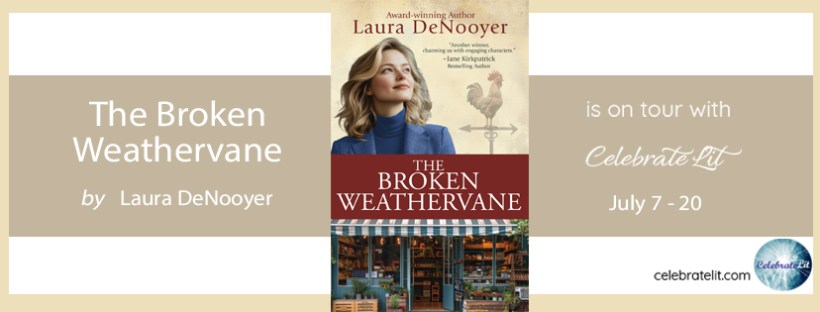
Book: The Broken Weathervane
Author: Laura DeNooyer
Genre: Women’s fiction, dual timeline fiction, literary fiction, book club fiction
Release Date: September 2, 2025
Two co-workers seek the same information. One wants to publish it; the other has good reasons to keep it hidden.
As Leslie Wickersham, Raymond University grants officer, seeks information to unravel a family mystery, English professor Gregory Stafford seeks an elusive interview with one more Buckwalter relative for his upcoming author biography. While Greg and Leslie guard coveted details from each other, her goals are further complicated by letters of blackmail threatening to reveal all she has worked hard to hide.
In this dual timeline novel alternating between 2015 and the 1950s, loyalty is tested and secrets abound when family honor collides with truth. Leslie grapples with the trade-off: how far will a person go to help a loved one thrive?
Click here to get your copy!
About the Author

Laura DeNooyer thrives on creativity and encouraging it in others. A Calvin College graduate, she is a teacher, wife, parent of four adult children, and an award-winning author of heart-warming historical and contemporary fiction. Her novels are perfect for fans of Patti Callahan Henry, Erin Bartels, or Amanda Cox. When she’s not writing, you’ll find her reading, walking, drinking tea with friends, or taking a road trip.
More from Laura
The Shame of Silence
In the 1950s, nobody talked openly about mental illness. We think it’s stigmatized today; it was worse then.
When a family member is physically ill or in an accident, folks will line up outside your door to bring comfort or casseroles. It’s an easily shared prayer request. But when a family member has an episode related to mental illness, it’s shrouded in secrecy and shame. Thus, the people most needing prayers and support don’t get them.
That’s the experience of Fritz, Eddie, and Klara Buckwalter in the 1950s timeline of The Broken Weathervane.
Leave It to Beaver
Television in the 1950s became a household word with its daily entertainment. Sitcoms included Danny Thomas’s Make Room for Daddy, I Love Lucy, Our Miss Brooks, and Father Knows Best. Variety shows like The Ed Sullivan Show along with comedy shows featuring George Burns, Jack Benny, and Red Skelton had viewers laughing in living rooms across America.
But those shows illuminated the lighter side of life. Today, we fondly embrace the innocence and nostalgia of Leave It to Beaver. But that’s far-fetched from everyday realities. Especially for those plagued by mental illness.
Old Dog, New Tricks
In the 2015 timeline, two co-workers are at cross purposes—both seeking the same information for different reasons.
When my protagonist Leslie Wickersham is hired as the grants officer at Raymond University, she doesn’t count on having to teach an old dog new tricks. By dog, I mean the brassy, pretentious English professor, Dr. Gregory Stafford—who isn’t all that old, but is behind the times.
The dean expects Leslie to drag Greg into the 21st century via social media, something Greg has relegated to the annals of Hogwash and Absurdity.
Their proximity becomes her chance to pick his brain for nuggets from his upcoming biography of local author Linus Fritz Buckwalter.
But she can’t let him know that Fritz is her great-uncle. Or that the one last interview Greg is holding out for—Klara Buckwalter—is Leslie’s grandmother.
Due to Klara’s silence, Leslie hopes Greg holds the key to knowledge about the family rift.
Answers start appearing when Klara gives Leslie her 1950s diary. The answers are shocking—but also contradict Greg’s research.
If you appreciate stories with:
- small town family secrets
- family drama
- dual timelines (2015 and 1950s)
- moral dilemmas
- family loyalty vs. honesty
- an honest, tender treatment of mental illness
. . . then this story will touch your heart.
My hope is that book club discussions will help increase understanding, transparency, and empathy for those who suffer. Open dialogue about mental illness is that important first step toward reducing the stigma associated with it. The Broken Weathervane is the perfect catalyst for that.
Interview with Laura
What are your favorite books to read?
I love reading the kind of stories I like to write—complex and character-driven with complicated relationships and messy family dynamics. I like delving into the gray, murky areas of life, into false appearances and misjudgments. My stories serve food for thought as well as hope and second chances—tales that “redeem the years the locusts ate.”
I enjoy the contemporary novels of Katie Powner with their simple rural and small-town settings populated by down-to-earth, three-dimensional characters. I admire Erin Bartels for strong, moving literary stories that defy genre parameters and formulas. I love the contemporary and historical fiction of Patti Callahan Henry.
I’ve read numerous dual timeline novels by Melanie Dobson, Michelle Shocklee, Amanda Wen, and others before I ever tried to pen my own split-time fiction. I learn to be a better writer by reading—by analyzing, discerning, and asking questions, such as how does the author make me care for these characters? How does the author keep tensions high, raising the stakes? And many more.
How do you create your main characters?
It depends on the story. I usually start with a premise and a few characters that I get to know along the way.
For The Broken Weathervane, some characters were inspired by a family story my dad shared over the years. His father and uncle were in business together with their youngest brother who struggled quite a bit. The two older brothers did everything in their power to help him succeed in his own businesses and later let him work at theirs. I loved the way they cared for him despite all the difficulties they encountered. I often wondered what the issues were.
This was the spark of the 1950s timeline in my novel. Then the characters took on lives of their own. The personalities of the Buckwalter brothers developed as the story progressed. While revising, I fleshed them out as I revisited each scene.
In the 2015 timeline of The Broken Weathervane, I needed two people at cross purposes with each other—both seeking the same information for different reasons.
Greg needed to be an English professor who was writing a biography about a literary icon, Fritz Buckwalter. I knew Leslie’s family tree but had to figure out her backstory and how her life would overlap Greg’s at the university. So, I gave her an education background (as a former high school teacher). I made her a grants officer at the college so she would have to work directly with Greg from time to time.
Leslie has good reasons to keep the information under wraps to protect her family’s privacy. Greg has no idea that Leslie is related to Fritz Buckwalter.
What would you say is the most difficult part of writing a book?
The most difficult part is making everything believable in order to give the reader the experience of being in the narrative “dream” and not be pulled out of the story for any reason. This involves capturing situations, personalities, and all the elements of fiction (characterization, setting, dialog, tone, etc.) and molding them into a perfect blend, scene after scene. No small feat!
In The Broken Weathervane, I had an additional challenge. Eddie, a character in the 1950s timeline, struggles with mental illness. I didn’t use Eddie’s point of view because I didn’t think I could do him justice, considering his hurdles. So, I instead wrote from the perspectives of his wife Klara and his brother Fritz. I think that helps in making Eddie a sympathetic character. Despite their aggravation and confusion about his antics, they love him dearly.
What was one of the most surprising things you learned in creating your books?
Over the years of penning stories, I learned how much my writing is cathartic as an exploration of the soul.
A Thomas Jefferson quote comes to mind: “I cannot live without books.” That’s true for me too, but I could add, “I cannot live without writing.”
Writing has served as a creative outlet, a catalyst for ideas, a source of solace, and a way to explore a myriad of confusing thoughts and feelings. I wrestle with difficult events and emotional challenges from my own experiences as these scenarios somehow wind up in my stories, bringing fresh insights, fostering empathy, stretching my limits and my faith. That makes story writing a form of journaling.
In The Broken Weathervane, I explored themes of transparency, honesty, mental illness, family loyalty, and challenging family dynamics—all things I’ve dealt with in real life.
Writing is a journey, not just a means to an end. As a teacher, I always taught that the writing process—or any creation of art—is just as important as the product, if not more so. It’s what we learn along the way that gives it meaning.
How many books have you written? Which is your favorite?
I’ve published three literary historical fiction novels. Two are dual timeline. One is Southern fiction. One is biographical fiction (about L. Frank Baum, The Wizard of Oz author). The settings range from North Carolina to the Midwest (Michigan and Wisconsin).
I have two book releases coming up in September 2026 and January 2027. The first one is House of Wind, contemporary women’s fiction about the wife of a narcissist pastor. The second is Rain in the Wilderness, Biblical fiction set in the time of Christ.
I’ve always written the story of my heart. I don’t choose the genre; it chooses me. This has led to genre hopping. Many pros advise authors to find their lane and stay in it to brand themselves. But I find that staying in my lane sometimes runs counterpoint to writing the stories that really matter to me.
My favorite book? That’s hard to say. It’s like asking which child is your favorite. I love each of my stories for different reasons. They each have a part of my heart in them. And a lot of sweat equity!
Blogs Stops
Simple Harvest Reads, July 7 (Author Interview)
She Lives To Read, July 8
Artistic Nobody, July 9 (Author Interview)
Guild Master, July 10 (Author Interview)
Debbie’s Dusty Deliberations, July 10
Fiction Book Lover, July 11 (Author Interview)
Book Reviews From an Avid Reader, July 12
The Bookish Ledger, July 13 (Author Interview)
A Modern Day Fairy Tale, July 14 (Author Interview)
Truth and Grace Homeschool Academy, July 14
Books Less Travelled, July 15 (Author Interview)
Texas Book-aholic, July 16
History, Hope & Happily Ever After, July 17 (Author Interview)
Lily’s Corner, July 18
Paula’s Pad of Inspiration, July 19 (Author Interview)
Stories By Gina, July 20 (Author Interview)
 Stories By Gina
I enjoyed the interview.
LikeLike
I enjoyed the interview with Laura DeNooyer. The quote she shared from Thomas Jefferson and her own addition resonate with me.
LikeLike
What is your favorite part of the writing process?
LikeLike